





15 de October de 2026
Innovación
Calidad y cadena alimentaria
Resiliencia y competitividad
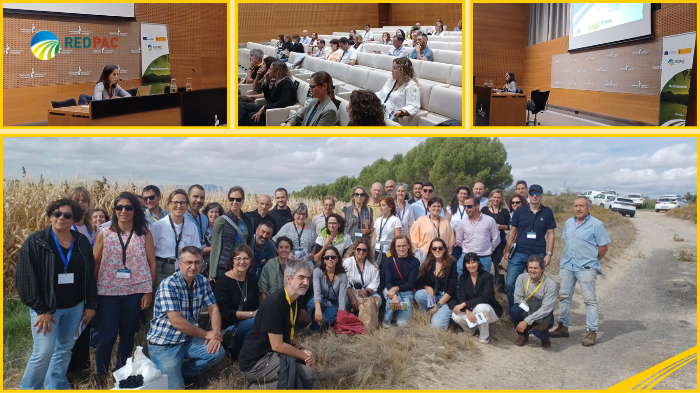
The Red PAC event “Good practices associated with Bt maize cultivation” combined sessions on regulation, traceability, labeling, official control and resistance prevention with a visit to a Bt maize farm in Larraga (Navarra) to learn about the application of these good practices on the ground
The Red PAC event “Good practices associated with Bt maize cultivation” combined sessions on regulation, traceability, labeling, official control and resistance prevention with a visit to a Bt maize farm in Larraga (Navarra) to learn about the application of these good practices on the ground
In 2024, Spain accounted for 98.7% of the area of MON 810 maize cultivated in the European Union, where it is currently the only genetically modified (GMO) crop authorized for commercial cultivation.
Spain accounts for the majority of the area planted with genetically modified corn (MON 810). Grown in the European Union (EU). In this context, understanding best practices for its cultivation, regulatory requirements, and official control obligations for MON 810 is especially relevant for farmers, technicians, and government agencies. The CAP Network brought these stakeholders together in Navarre to shift the discussion to the realm of knowledge: regulations, traceability, resistance prevention, and best practices for a crop that has been present in Spanish fields for over 25 years.
On October 6th, the CAP Network organized the "Good Practices Associated with Bt Maize Cultivation" workshop in Pamplona (Navarra) . The event aimed to improve knowledge about agronomic management, regulatory requirements, and environmental monitoring of the genetically modified MON 810 maize . The theoretical session, held at CIVICAN , was followed by a visit to a Bt maize farm in Larraga (Navarra) to demonstrate the application of good practices, crop management, and the identification of potential damage caused by the two main maize borer species present in the area.
The event was aimed at farmers, technical staff, the scientific community, regional administrations with responsibilities related to genetically modified organisms ( GMOs ), and representatives of the sector.
The meeting focused on a unique crop within the EU context. MON 810 is currently the only genetically modified (GMO) crop authorized for commercial cultivation in the EU . In fact, the data presented during the event indicated that 98.7 % of the EU's MON 810 acreage was located in Spain in 2024, with the remainder in Portugal, where the cultivated area has been steadily declining in recent years.
In Spain, its cultivation is concentrated especially in Navarre, Aragon, and Catalonia , according to information presented during the event. The Ministry of Agriculture, Fisheries and Food (MAPA) also has public information available on the cultivated area, regulations, monitoring, and best practices associated with MON 810 maize in Spain .
MON 810 maize offers protection against certain pests known as corn borers : Ostrinia nubilalis and Sesamia nonagrioides . The plants produce the protein “Cry1Ab”, which confers resistance to these target pests. The crop has been authorized in the EU since 1998 and is subject to a post-marketing Environmental Monitoring Plan .
Traceability, labelling and official control of MON 810 corn
One of the main sections of the day focused on the regulatory framework for MON 810 corn cultivation and, in particular, on the obligations related to traceability, labeling, crop declaration and cross-border coexistence.
During the session, it was explained that traceability allows tracking GMOs and products made from them throughout the production and distribution chains.
Operators must transmit in writing to the next link in the chain the information that identifies the material as GMO and its unique identifier, MON-ØØ81Ø-6 , and have systems that allow the information corresponding to each commercial transaction to be kept for five years, specifying the operator from whom they come and the one to whom the products have been supplied.
Labeling is another obligation analyzed. Seeds containing GMOs must be identified as such, and in this case, the 0.9% threshold for authorized GMOs established for certain food and feed products does not apply, provided that these traces are accidental or technically unavoidable.
These obligations are in addition to the declaration of the crop in the single CAP application , in which it must be indicated that it is a genetically modified variety, as well as its surface area and the exact location of the corresponding plot.
Holding this event in Navarre also allowed for special attention to be paid to cross-border coexistence with France . Farmers cultivating genetically modified corn varieties must maintain a 20-meter buffer zone from the French border, including any refuge or barrier areas established on the same plot.
The presentation also made it possible to assess the extent of the crop's implementation in the Foral Community of Navarre: in 2026, 458 of the 1,102 Navarrese farms that cultivate corn produce Bt corn , while 6,200 of the 12,370 hectares dedicated to corn correspond to this type of crop.
Environmental monitoring, refuges and good practices to prevent resistance
Along with compliance with regulatory and control requirements, another central focus of the day was the Post-Marketing Environmental Monitoring Plan (PMEM) for MON 810 corn and the measures that have been adopted to prevent the emergence of resistance in the borer populations.
Thus, among other measures, the following are specified:
Refuge planting : conventional corn refuges near Bt crops are one of the tools used to prevent the emergence of resistant corn borer populations and help preserve the effectiveness of the technology. For areas of 5 hectares or more of Bt corn, the plan recommends planting a backup crop of traditional corn equivalent to 20% of the corresponding area.
Monitoring resistance and damage in the field . As explained at the conference, each year, borer larvae are collected from sampling areas in Aragon, Catalonia, and Navarre to be subjected to laboratory bioassays and to test their susceptibility to the Cry1Ab protein. These actions are complemented by surveys of farmers, visits to farms, checks of refuges, and monitoring for potential borer damage.
Monitoring reports: The authorization holder submits an annual monitoring report to the European Commission and the European Food Safety Authority (EFSA) . EFSA assesses the information and issues its corresponding technical opinions and recommendations. EFSA's most recent opinion on the environmental monitoring of the MON 810 maize crop, published in August 2026, can be found at the following link .
From theory to the field in Larraga
The last part of the day allowed the content covered in Pamplona to be transferred from theory to the field, through a visit to a Bt corn producing farm in Larraga (Navarra).
During the visit, demonstrations were carried out on the application of good practices and regulatory requirements, the taking of samples during crop control and the identification and observation of damage in the field, with the participation of technical staff from the National Association of Plant Breeders ( ANOVE ) , Government of Navarra and Navarre Institute of Agri-food Technologies and Infrastructures ( INTIA ) .
The event thus brought together regulations, environmental monitoring, administrative control, and agronomic practices related to a single crop, and transferred that knowledge to farmers, technicians, administrations, and other stakeholders involved with MON 810 maize. This approach demonstrates how the CAP Network continues to serve as a platform for meeting, connecting, and exchanging knowledge among actors in the rural sector.
To learn more
CAP Network Workshop “Good practices associated with Bt maize cultivation”
Latest EFSA opinion: Scientific assessment of the 2024 post‐market environmental monitoring report on the cultivation of genetically modified maize MON 810 in the EU (2026 - EFSA Journal - Wiley Online Library)
Commercial corn cultivation MON 810 - Government of Navarre, Department of Rural Development and Environment